
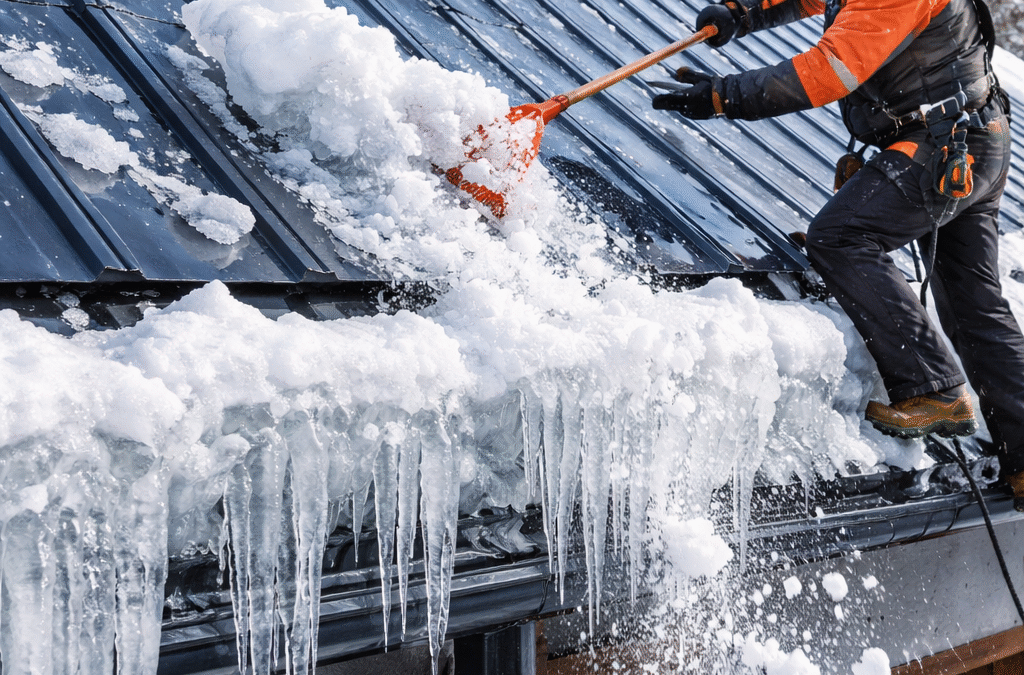
If you’ve owned a home in Minnesota for at least one winter, you know the signs of ice dams. A thick ridge of ice along the edge of your roof. Icicles hanging off the gutters that look impressive until you realize what’s causing them. And then, the part nobody sees until it’s too late, water finding its way inside your walls and ceilings. Giving you another expensive problem to deal with.
Ice dams are one of the most common and most costly winter problems for Minnesota homeowners. They’re also one of the most misunderstood. Most people treat them as a roofing problem. The truth is they’re a roofing problem, an insulation problem, and a ventilation problem all at once, and your choice of roofing material determines how much damage they can do.
Here’s what’s actually happening, why asphalt shingles make it worse, and why metal roofing changes everything.
Table of Contents:
- What Is an Ice Dam? (The Simple Version)
- What Ice Dams Actually Do to Your Home
- Why Asphalt Shingles Make Ice Dams Worse
- How a Metal Roof Stops Ice Dams From Forming
- What Minnesota Homeowners Actually Experience
- Not Sure Which Metal Roof Is Right for Your Home?
- Get a Metal Roof Before Next Winter Hits
What Is an Ice Dam? (The Simple Version)
Picture your roof after a snowstorm. Snow is sitting on top of it.
Inside your house, heat rises into the attic. That heat warms the roof deck (the wood underneath the shingles) which melts the snow sitting on top. The meltwater starts running down the roof toward the edges. Here’s the problem: the edges of your roof don’t get that attic heat. They stay cold. So when the meltwater reaches those cold edges, it refreezes.
Now you have a wall of ice at the edge of your roof. More meltwater comes down behind it and has nowhere to go. It pools up. It sits there. And eventually, it finds somewhere to go, which is usually through your roof and into your home.
That’s an ice dam. And in Minnesota, where temperatures swing above and below freezing regularly all winter long, the cycle repeats itself over and over until the snow melts for good in spring.
What Ice Dams Actually Do to Your Home
Ice dams aren’t just a roof problem. Here’s what happens to your home if they go unaddressed:
Water gets into your ceilings and walls.
This is the most common and most expensive consequence. Backed-up water works its way under roofing materials and into the structure of your home. You’ll see it as water stains, bubbling paint, or wet drywall.
Insulation gets soaked.
Wet insulation stops working. Once it’s saturated, it loses most of its ability to keep your home warm and it stays wet long after the ice is gone, creating a perfect environment for mold.
Gutters get destroyed.
The weight of a serious ice dam can tear gutters right off the house. We see this every spring across the Twin Cities.
Structural damage builds over time.
Water that repeatedly gets into the wood structure of a home causes rot. By the time you notice it, the damage has already gotten worse.
This is why ice dams are a much bigger deal than homeowners think.
Why Asphalt Shingles Make Ice Dams Worse
Asphalt shingles aren’t designed for this scenario. They’re designed to shed water that’s falling downward. They’re not designed to stop water that’s being pushed upward. This is exactly what happens when backed-up water sits behind an ice dam. Shingles have seams. They have overlapping edges. Water under pressure finds those gaps.
Beyond that, shingles are textured and rough. Snow and ice grip them. Once an ice dam forms, it expands and locks onto the shingle surface rather than releasing naturally. Every winter, the freeze-thaw cycle works on those shingle seams. Expanding them, weakening them, letting a little more water through each time. An asphalt roof in Minnesota wears out faster partly because of this repeated ice dam stress.
How a Metal Roof Stops Ice Dams From Forming
Metal roofing doesn’t fix the underlying cause of ice dams — that’s an insulation and ventilation issue inside your attic. But it changes the outcome completely.
- Metal is slippery.
Snow doesn’t grip a metal roof the way it grips asphalt shingles. It slides off. That means less snow accumulation, less meltwater, and significantly less opportunity for ice dams to form in the first place. You’ll often see a metal roof shed snow naturally while the asphalt roofs on neighboring houses are still loaded down.
- Metal panels are sealed.
Modern metal roofing systems standing seam in particular use interlocking panels and concealed fasteners that create a watertight seal. Even if some water does back up behind ice accumulation, it doesn’t find the gaps and seams that let it into an asphalt roof. The water that gets under asphalt shingles simply can’t penetrate a properly installed standing seam system the same way.
- Metal doesn’t degrade from freeze-thaw cycles.
While asphalt shingles weaken over time from repeated freezing, thawing, and refreezing, metal handles those cycles without the same deterioration. A metal roof in Minnesota at year 20 is performing the same way it did at year 1.
What Minnesota Homeowners Actually Experience
Think about it this way. Two neighbors. Same street. Same winter. Same amount of snowfall.
The house with asphalt shingles: snow piles up on the roof, warms from below, melts slowly, backs up at the cold eaves, freezes, and forms ice dams. Water starts working its way into the attic. In February, there’s a stain on the bedroom ceiling.
The house with standing seam metal: snow slides off before it has a chance to melt and back up. What little does accumulate doesn’t find a way through the sealed panel system. No water stain. No soggy insulation. No gutter damage. Just a roof doing its job through the whole winter.
It’s what we see year after year from homeowners who’ve made the switch.
Not Sure Which Metal Roof Is Right for Your Home?
There’s more than one type of metal roofing, and they’re not all the same. Standing seam, stone coated, ArrowLine, metal shake. Each one has a different profile, different price point, and different strengths.
Read our guide to choosing the best type of metal roof for your Minnesota home →
It covers every option we install, what each one costs, and which one makes sense for different home styles and priorities.
Get a Metal Roof Before Next Winter Hits
Summer is the best time to plan a metal roof installation, our crews are available, weather cooperates, and you’ll be protected before the first snowfall of the season.
New Century Exteriors has been installing metal roofing across the Twin Cities metro for over 20 years. We’ll help you choose the right system for your home, your neighborhood, and your budget. And we install it with the craftsmanship it takes to actually deliver on everything metal roofing promises.
Contact New Century Exteriors to schedule your free estimate →